
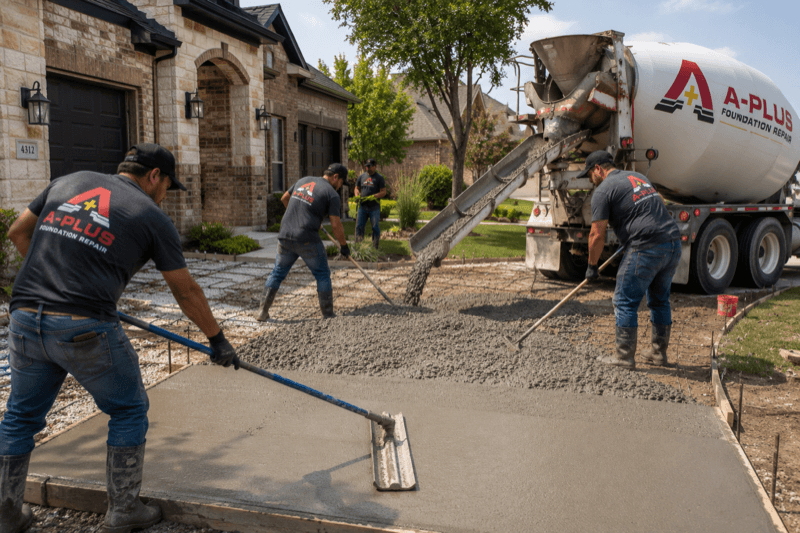
The Hidden Danger Destroying Homes in Plano
Budget contractors in Plano often pour thin, unreinforced concrete driveways and patios that quickly shatter and heave under the extreme pressure of our shifting Texas clay.
The typical Plano foundation is a 1980s to 2000s slab-on-grade, generally built to a decent standard for its era. These are not badly built homes. They are well-built homes sitting on soil that moves more than the slab can accommodate, which is a different problem and needs a different answer than patching.
Why Waiting Will Cost You Thousands
Foundation failure doesn't fix itself; it accelerates. What starts as a hairline crack in your drywall can quickly turn into thousands of dollars in sheared plumbing lines beneath your slab. The longer you wait to address the shifting soil in Plano, the more expensive the collateral damage becomes. A+ Foundation Repair offers free evaluations to catch these issues early.
"A+ Foundation Repair completely saved our home. The cracks in the brick were terrifying, but their crew came out to Plano, explained everything clearly, and the repair was flawless. I can finally sleep at night knowing our home is secure."
- Verified Customer in North TexasThe Science of Plano Soil
Concrete has immense compressive strength but terrible tensile (bending) strength. When the Plano soil heaves, unreinforced concrete simply snaps. A+ Foundation Repair heavily reinforces our flatwork with steel rebar, giving the concrete the flexibility it needs to survive the aggressive Texas soil movement.
Plano sits squarely on the Blackland Prairie. The clay beneath it is deep and highly plastic, meaning there is a great volume of material available to change size as moisture changes. Between a wet spring and a drought summer the ground under a Plano home can move several inches vertically, and it does not move uniformly — the perimeter dries first and drops first while the center, insulated by the slab itself, stays put.
Plano's mature tree canopy is the complicating factor. A large live oak or elm can draw hundreds of gallons a day out of the soil in summer, and when it is planted fifteen feet from the house, it is drawing that water out from under the foundation. A great deal of Plano settlement is localized to one corner, and when elevations are mapped the low point is often on the side with the largest tree.
Independent sources: soil classifications for Collin County can be looked up through the USDA Web Soil Survey, and Texas A&M AgriLife Extension publishes guidance on managing expansive soils around Texas foundations.
The A+ Foundation Repair Difference
We engineer heavy-duty, steel-rebar reinforced flatwork explicitly designed to withstand the brutal soil movement of Plano, resulting in beautiful driveways and patios that last decades.
Plano homeowners often ask whether they should remove the tree. Usually the answer is no. A root barrier installed between the tree and the foundation redirects growth downward and solves the mechanism without costing you forty years of shade and a significant amount of property value.
Protecting your property value in Plano
A shattered driveway destroys the curb appeal of your Plano home. Our premium concrete flatwork is an investment in aesthetics and durability, dramatically enhancing the exterior look and resale value of your property for decades to come.
Permits and inspections in Plano
Collin County municipalities generally require a permit for structural foundation repair, and an engineer's report is commonly part of the package on larger scopes. We confirm what Plano requires for your specific job and file it as part of the work.
Where we do concrete flatwork in Plano
We serve all of Plano, from the older east-side neighborhoods near downtown out through the Legacy and Willow Bend corridors.
- West Plano
- Legacy West
- Willow Bend
- Old Town Plano
- Los Rios
- Deerfield
- Preston Meadow
Concrete Flatwork in Plano: Frequently Asked Questions
Specific answers about concrete flatwork for Plano homeowners, including local soil conditions, permitting in Collin County, and what drives the price.
What does concrete flatwork include?
Flatwork covers the horizontal concrete around your property: driveways, sidewalks, patios, porches, and slabs for outbuildings. It is separate from structural foundation work but it lives on the same moving North Texas clay and it fails for the same reasons.
Why does concrete crack so badly in North Texas?
Concrete is strong in compression and weak in tension. When expansive clay heaves in one spot and drops in another, the slab is put into bending, and unreinforced or thin concrete simply snaps. Adequate thickness, proper steel reinforcement, and correct subgrade preparation are what let flatwork survive here.
How thick should a driveway be?
For residential driveways in this soil, thicker than the minimum a budget bidder will quote you, and reinforced with steel. A driveway that has to carry a truck or an RV needs more still. We specify thickness and reinforcement based on actual use rather than on hitting the lowest possible number.
Should I repair or replace my cracked driveway?
If the concrete is structurally intact and has simply settled, pressure grouting to lift it back into plane is far cheaper than replacement. If the slab is shattered into multiple pieces, badly spalled, or was poured too thin to begin with, replacement is the honest answer. We tell you which situation you are in.
Why is concrete flatwork needed so often in Plano?
Plano sits squarely on the Blackland Prairie, whose highly plastic clay can change volume dramatically between a wet spring and a drought summer. Homes in Plano sit directly on that ground, and concrete flatwork addresses the damage it causes rather than just the cosmetic symptoms above it.
How much does concrete flatwork cost in Plano?
Pricing depends on the size of the affected area, how far the structure has moved, and what the deep Blackland Prairie clay beneath your property requires. We do not quote Plano jobs over the phone without measuring, because a number given sight-unseen is a guess. Evaluations are free and the written estimate is what you pay.
Do I need a permit for concrete flatwork in Plano?
Structural work generally requires a permit in Collin County municipalities, and some cities also require an engineer's report. We pull whatever permits Plano requires as part of the job. Non-structural work such as flatwork or drainage may have different requirements, and we confirm before starting.
How quickly can you get to my Plano property?
Plano is inside our regular service area and we schedule evaluations there continuously. Call (972) 436-2595 and we will book the soonest available slot. If you have an active, fast-moving problem, tell us when you call and we will prioritize it.
Is concrete flatwork in Plano covered by a warranty?
Our foundation leveling work carries a Lifetime Transferable Warranty, and other services carry warranties appropriate to the work performed. We explain exactly what your Plano job is covered for, in writing, before you sign anything.
Thousands of Satisfied DFW Homeowners
Don't just take our word for it. See why A+ Foundation Repair is the highest-rated structural contractor in Plano.
Trusted by Homeowners
Don't just take our word for it. See what our clients are saying.
Texas Weather Changes Fast. Don't Wait.
Foundation damage doesn't fix itself—it only gets more expensive. Protect your home's value before the next heavy rain cycle shifts your soil. Get a completely free, no-pressure structural evaluation today.